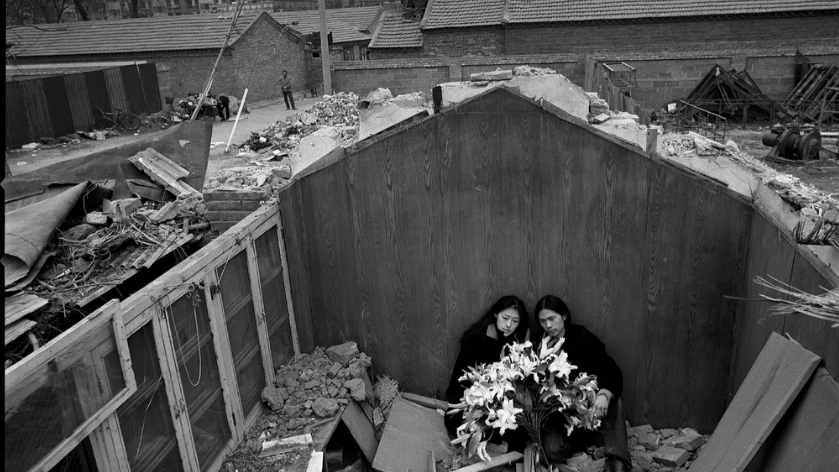
Rong Rong
Introduction
Rong Rong is a distinguished Chinese photographer renowned for his pioneering work in documenting performance art and his significant contributions to contemporary photography in China. After graduating in 1992 from the Central Academy of Arts and Crafts in Beijing, Rong Rong relocated to Beijing's East Village, a burgeoning hub for avant-garde artists. Here, he captured the essence of the community through his lens, documenting the lives and performances of his fellow artists.
Rong Rong's work is renowned for its intimate portrayal of the socio-cultural transformations that have shaped contemporary China. Notably, his collaboration with his partner Inri from 2000 onwards has further enriched his artistic oeuvre. Together, they co-founded the Three Shadows Photography Art Centre in Beijing in 2006, which has become a pivotal institution in the Chinese and international photography scene.
Early Life
Li Zhirong, known professionally as Rong Rong, was born in Zhangzhou, Fujian Province, in 1968. From a young age, Rong Rong showed an interest in the visual arts, which led him to pursue formal education in photography. He attended the Central Academy of Arts and Crafts in Beijing, where he honed his skills and graduated in 1992. His academic training provided him with the technical expertise and artistic sensibility that would later mark his distinctive style.
During his formative years, Rong Rong was deeply influenced by the socio-economic changes occurring in China and the burgeoning art scene in Beijing. The environment fostered his artistic development, encouraging him to explore themes of identity, transformation, and cultural heritage through photography. His early exposure to diverse artistic expressions in Beijing's East Village proved pivotal, as it was here that he immersed himself in the vibrant community of experimental artists.
Career
Artistic Style
Rong Rong's artistic style is characterized by a meticulous attention to detail and a profound sensitivity to the subject matter. His work often blurs the boundaries between documentary and fine art photography, capturing ephemeral moments with an enduring impact. In the East Village, he documented the experimental performances of artists such as Zhang Huan, Ma Liuming, and Zhu Ming. His photographs serve as an invaluable archive of performance art, preserving the fleeting nature of these avant-garde expressions. Rong Rong's images are distinguished by their raw, unfiltered representation of the human condition, often juxtaposing the mundane with the extraordinary.
His collaboration with his wife Inri introduced a new dimension to his work, as they explored themes of intimacy, identity, and the evolving relationship between individuals and their environment. Together, they have created a body of work that is both autobiographical and universally resonant, reflecting the socio-cultural dynamics of contemporary China.
Major Works
Rong Rong's major works include iconic series from the East Village era, such as Zhang Huan's "12 Square Metres" (1994), Ma Liuming's "Fen-Ma Liuming's Lunch" (1994), and Zhu Ming's "Performance No. 6" (1997). These photographs capture the raw energy and creativity of the artists, set against the backdrop of a rapidly changing urban landscape.
His collaboration with Inri has yielded several acclaimed series that delve into personal narratives and environmental themes. Notable works include their early collaborative series that document their everyday life amidst the ruins of demolished urban areas, reflecting on themes of loss, resilience, and renewal. These works have been exhibited in prestigious galleries and festivals worldwide, cementing Rong Rong's status as a leading figure in contemporary photography.
Achievements and Awards
Rong Rong's contributions to the field of photography have been widely recognized, earning him numerous accolades and awards. In 2016, he received the Outstanding Contribution to Photography Award from the World Photography Organisation (WPO), acknowledging his significant impact on the art form.
His work has been featured in major international exhibitions, and he has been an influential advocate for photography in China. Alongside Inri, Rong Rong co-founded the Jimei x Arles International Photo Festival, which has become a seminal platform for showcasing contemporary photography from China and around the world. The festival has garnered praise for its innovative curation and its role in fostering cross-cultural dialogue. Through these accomplishments, Rong Rong has played a crucial role in elevating the status of photography as a respected art form in China and beyond.
Influence and Impact
Rong Rong's influence extends beyond his photographic work, shaping the broader landscape of contemporary art in China. His documentation of the East Village community has preserved an essential chapter of Chinese art history, providing insights into the experimental practices that emerged during a period of significant socio-cultural change.
As a curator and educator, Rong Rong has been instrumental in nurturing talents and fostering a supportive environment for emerging photographers. The Three Shadows Photography Art Centre, which he co-founded, serves as a hub for artistic exchange and innovation, offering exhibitions, workshops, and educational programs that engage diverse audiences.
Through his initiatives and collaborative projects, Rong Rong has contributed to the global recognition of Chinese photography, inspiring a new generation of artists to explore the medium's potential. His work continues to resonate with audiences worldwide, challenging perceptions and inviting reflection on the complexities of contemporary life.








